Contact Us

224 S. Dawson St.
P.O. Box 26626
Raleigh, NC 27611
(800) 777-5869
Tel. (919) 856-2180
Fax (919) 856-2187

About NC Farmworkers

Much of the following information was first published in a series of fact sheets prepared for the public by the North Carolina Farmworker Institute, a project of the North Carolina Council of Churches‘ Farmworker Ministry Committee.  You can find the complete series at www.ncfarmworkers.org.

Topics on this page:

  • Migrant or Seasonal Farmworkers
  • Demographics
  • Major Employers of Farmworkers
  • Contributions to NC’s Economy
  • Legal Inequities: Minimum Wage | Child Labor | Unemployment | Workers Compensation
  • Occupational Health Risks
  • Citizens, Immigrants and Non-Immigrants

  • Migrant or Seasonal Farmworkers?

    The adjective “migrant” does not connote any particular ethnicity or citizenship or immigration status.  Migrant farmworkers are workers who travel away from their homes overnight to work in agriculture (1).  Migrant farmworkers move into temporary housing while they are in North Carolina.  Seasonal farmworkers also work in agriculture, but live in one community year-round (2).

    Back to Top

    Demographics

    North Carolina ranks sixth in the nation in the number of migrant farmworkers, after California, Texas, Washington, Florida, and Oregon, according to the most recent study performed for the federal migrant health program (3).  This same study estimated that approximately 150,000 migrant farmworkers and their dependents are present in North Carolina each growing season.

    The 2005 National Agricultural Workers Survey of the U.S. Department of Labor, the most recent authoritative sampling of farmworkers nationally,  found the following characteristics apply to farmworkers nationally (4):

    • Most are younger than 31
    • 80% are male
    • Most have spouses or children who remain in their home countries
    • 75% were born in Mexico
    • 53% are undocumented, 25% are U.S. citizens, and 21% are legal permanent residents
    • Average annual income for a farmworker family of four of  is about $16,000
    • 13% have completed high school, and the median highest grade completed is the 6th

    These same characteristics are generally true for North Carolina’s migrant farmworkers, however North Carolina agriculture also employs many non-immigrant H-2A workers from Mexico (5).  H-2A workers are admitted to the United States on special seasonal visas which allow them to work only for the employer who filed the petition for their visas.  In addition, workers from Mexico, Guatemala and Honduras are employed in North Carolina planting trees and doing other reforestation tasks on similar seasonal visas, called H-2B visas.   The Farmworker Unit estimates between 6% and 10% of migrant farmworkers in North Carolina are either H-2A farmworkers or H-2B forestry workers.

    Another difference for North Carolina farmworkers is that farmworkers on the East Coast tend to earn about 35% less than the national average (6).  Nearly five out of ten farmworker households in North Carolina cannot afford enough food for their families (7).

    Back to Top

    Major Employers of NC Farmworkers

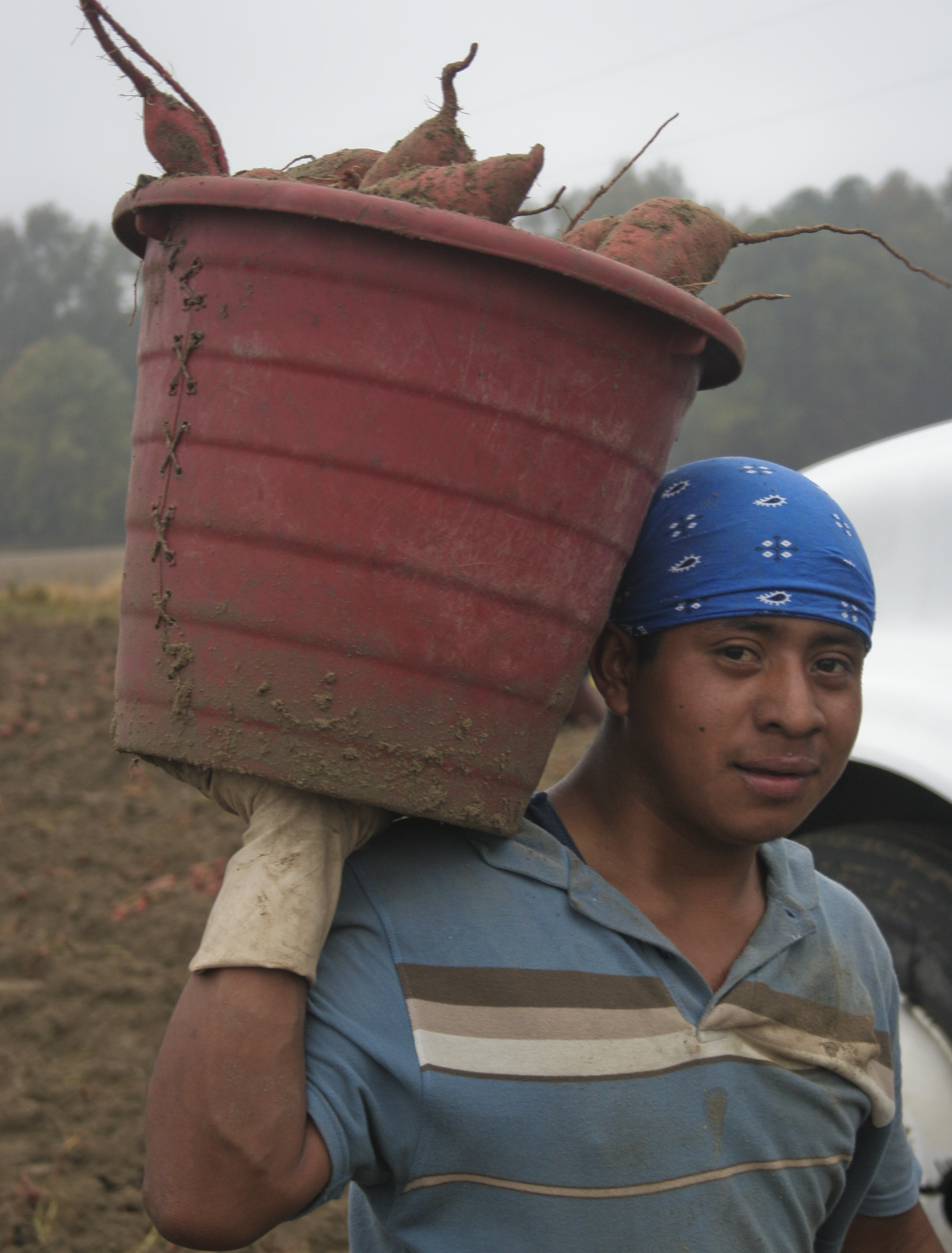
    Major North Carolina crops which require hand labor for cultivation or harvest include tobacco, Christmas trees, sweet potatoes, cucumbers, apples, and blueberries.  North Carolina ranks first in the nation in the production of tobacco, Christmas trees, and sweet potatoes (8).  In addition, North Carolina farms grow a large variety of other fruits and vegetables, and many farmworkers work in greenhouses, plant nurseries, and cotton gins.

    North Carolina also has large forests and tree plantations, where brush is cleared and trees are planted by migrant workers.

    Seasonal farmworkers provide the labor for North Carolina’s large hog and poultry farms.   North Carolina second in the nation in the production of hogs and turkeys (9).

    Back to Top

    Contributions to NC’s Economy

    Each farmworker’s labor is estimated to contribute more than $12,000 in profits to North Carolina’s agricultural economy (10).  In addition, much of farmworkers’ wages are spent in the counties in which they work, boosting local economies and providing jobs to local residents.

    Back to Top

    Legal Inequities for Farmworkers

    For many years, farmworkers were entirely excluded from the labor reforms of the 1920′s and 1930′s — child labor prohibitions, workers compensation, minimum wage and overtime pay, social security, unemployment compensation, and collective bargaining rights.

    Two of these exclusions remain absolute — overtime pay and collective bargaining rights.  The federal Fair Labor Standards Act still excludes agricultural workers from its overtime pay requirements, so no matter how many hours a farmworker works in a week, he or she is not required to be paid overtime (11).  The National Labor Relations Act, the federal law which sets out a structure and a process for collective bargaining, also still does not cover agricultural workers (12).

    Other exclusions have been trimmed over time and those laws now cover at least some agricultural workers.  Still, farmworkers have significantly fewer or weaker protections than other workers:

    Minimum Wage

    Originally in 1938, the Fair Labor Standards Act excluded all agricultural workers from its minimum wage protections.  Although farmworkers on larger farms were brought under the Act in 1966, until 1978 they were allowed to be paid a special lower agricultural minimum wage (13).   The law now requires workers on larger farms to be paid the regular federal minimum wage for all hours worked (14).  North Carolina excludes agricultural workers from its minimum wage and overtime law as well (15).

    Child Labor

    The Fair Labor Standards Act generally does not allow the employment of minors under the age of 16, and those under 18 cannot be employed in any occupation found to be particularly hazardous for minors or detrimental to their health or well-being (16).

    In agriculture, however, minors as young as 12 can be employed outside school hours on farms if they have parental written consent or are working with their parents.  Minors between 14 and 16 can work on farms outside of school hours without parental consent.  Minors 16 and over can be employed on a farm during school hours without parental consent and may also be employed in an occupations found to be particularly hazardous for minors (17).

    Unemployment Compensation

    Until 1978, agricultural workers were not covered by unemployment compensation.  Still many farmworkers lack access to unemployment coverage.  Current law provides that agricultural employers are required to pay unemployment insurance taxes if in the current or the preceding calendar year they either  paid agricultural employees at least $20,000 in wages in any quarter or employed at least 10 workers for at least a portion of a day in each of 20 different weeks (18).  In contrast, employers in other industries must pay unemployment taxes if the in current or preceding calendar year they paid at least $1,500 in wages in any quarter or if they employed at least 1 person for at least a portion of a day in each of 20 different calendar weeks (19).

    Workers Compensation

    Workers compensation is a system of insurance, mandated by state law, that provides free medical treatment for injuries or illnesses arising in the workplace.  A worker who loses more than a week of work due to the injury can also receive two-thirds of his or her average weekly wage for each week until he or she is cleared by the doctor to return to work.  From its inception In the early 20th century, in North Carolina, almost all farmworkers were not covered by workers compensation.

    Most businesses in North Carolina must provide workers compensation if they employ three or more workers whereas agricultural employers must provide workers compensation coverage under North Carolina law only if they employ ten or more year-round workers (20).

    Federal law governing the H-2A program requires employers of H-2A workers to provide workers compensation or comparable insurance.  Most North Carolina farms which have workers compensation insurance are those which employ H-2A workers.

    Back to Top

    Occupational Health Risks

    Agriculture is one of the most dangerous occupations in the United States (21).  The fatality rate for farmworkers in North Carolina is higher than the national average (22).

    Heat stress is a major cause of fatalities among farmworkers.  Between 1992 and 2006, 423 worker deaths were reported from heat strokes in the United States.  24% of these were in agriculture and related industries (23). During this period, heat stroke killed seven North Carolina farmworkers in five years, giving North Carolina the highest rate of heat related fatalities among farmworkers in the United States (24).  Despite efforts by the North Carolina Department of Labor to educate agricultural employers and workers about the dangers of heat and methods of preventing heat stress, workers have continued to die each year.

    Farmworkers also experience the highest rate of toxic chemical injuries and skin disorders of any workers in the United States (25). Nausea, vomiting, cramping and itchy/burning eyes are known short-term effects of acute pesticide poisoning.  Long-term health effects of chronic pesticide exposure include cancer, neurological disorders, miscarriage, memory loss, and depression (26).  24% of tobacco workers suffer from green tobacco sickness, or nicotine poisoning through the skin, at least once in a growing season (27).  The effects of green tobacco sickness include dizziness, nausea and vomiting, muscle cramps, and sleeplessness.

    Substandard or overcrowded housing and lack of field sanitation facilities can also put farmworkers at greater risk for occupationally connected illnesses and injuries.   Without field sanitation facilities (portable toilet, hand-washing facilities, and cool, potable drinking water with disposable individual cups), workers

    Back to Top

    Citizens, Immigrants, and Non-Immigrants

    North Carolina’s farmworker population is made up of citizens of the United States, immigrants (both documented and undocumented who make their home in the United States), and H-2A and H-2B workers who come to the United States on seasonal non-immigrant visas.  In addition, some who work on farms in North Carolina are not immigrants but have formal Dept. of Homeland Security permission to remain in the U.S. and be employed (28).

    In general, all persons in the United States, regardless of immigration status are entitled to some basic protections under the Constitution:  the due process of law and the equal protection of the law, as promised in the Fourteenth Amendment.

    This means that all farmworkers, regardless of citizenship or immigration status, have certain basic rights, including the rights to:

    • be paid for work performed and to receive the minimum wage and overtime if applicable;
    • receive a wage statement with wages which identifies among other things, the hours worked, the basis of the pay received, and all deductions from the pay;
    • live in housing which comports with the state and federal safety and health standards;
    • receive safety training before working with pesticides and other agricultural chemicals and to have proper protective gear provided and re-entry times observed after pesticide applications to fields;
    • have field sanitation facilities available to use;
    • receive free medical care and compensation for lost wages when injured on the job, if the employer has or should have workers compensation coverage;
    • require legal process if the landlord wants to evict them;
    • receive the visitors they choose while living in employer provided or rental housing; and to
    • be free from sexual harassment in the workplace or discrimination based on race, national origin, religion, or gender.

    While all the rights listed above pertain to all farmworkers, it is lawful for the federal and state government to make distinctions between citizens of the United States and citizens of other countries regarding certain privileges, such as public benefits.  Undocumented immigrants are not eligible for welfare, food stamps, Medicaid, and most other public benefits (29).  Immigrants who have lawful permanent resident (LPR) status are not eligible for public benefits, either, until they have had LPR status for at least 5 years (30).  Only U.S. citizens, lawful permanent residents, and those who have employment authorization from the Department of Homeland Security are eligible for unemployment.

    Back to Top

    Footnotes

    (1) 29 U.S.C. §1802(8)(A).
    (2) 29 U.S.C. §1802(10A).
    (3) Larson, A., Farmworker Enumeration Study, 2000.
    (4) National Agricultural Worker Survey, U.S. Department of Labor, 2005
    (5) In 2009, the U.S. Department of Labor approved applications from North Carolina farmers seeking 9,929 H-2A workers. (NC Employment Security Commission).
    (6) Krejci-Manwaring, J., Journal of Ag. Safety and Health, 2006.
    (7) Quandt, S. at al, 2006.
    (8) NC Department of Agriculture and Consumer Services, 2008.
    (9) NC Department of Agriculture and Consumer Services, 2008.
    (10) Larson, A., Farmworker Enumeration Study, 2000.
    (11) 29 U.S.C.§ 213(b)(12)
    (12) 29 U.S.C§152(3)
    (13) Public Law 93-259 §6(a), 88 Stat. 58, April 8, 1974.
    (14) 29 U.S.C. §206(a).
    (15) N.C.G.S. §95-25.14(a)(2).
    (16) 29 C.F.R. §570.2(a)(ii).
    (17) Id.
    (18) N.C.G.S. §96-8(5)(n).
    (19) N.C.G.S. §96-8(5)(a)
    (20) N.C.G.S.§97-2(1).
    (21) McCurdy, S. et al, American Journal of Industrial Medicine, 2003.
    (22) U.S. Department of Ag, 1999.
    (23) Morbidity and Mortality Weekly Report (2008). Heat-related deaths among crop workers, United States , 1992-2006.
    (24) Id.; Mirabelli, M.. and Weathers, A. et al, 2004.
    (25) National Institute for Occupational Safety and Health, 2004.
    (26) McCauley, L. et al, 2006.
    (27) Arcury, T. et al 2001.
    (28) These foreign nationals are not truly immigrants, but are recipients of special government protection, such as “temporary protected status” or TPS, which is granted to citizens of certain countries, such as Haiti, who cannot return to their home country because of natural disasters or war.
    (29) Rothenburg, D. With These Hands, 1998.
    (30) NILC Guide to Benefits for Immigrants, 2008.
    Back to Top
    Vea esta página en español.